Notes from the Shore · 03
The book updates now.
Twenty years ago, this post couldn’t exist.

I keep updating Into Alignment. Not the story — the sentences. If you bought the book three weeks ago, the copy you read isn’t quite the copy on sale today, and I want to be straight with you about that. The book has reached a level of stability where I’m pretty certain it won’t undergo major changes. That wasn’t true three weeks ago, when I first put it up for purchase.
Part of me feels weird about this, because it breaks the model of buying books. A book was an object. You bought it, it was printed, it was done. The other part of me got over it fast.
First, the deal, and it isn’t a promotional trick: if you bought the print book and want the current one, email a photo of the copy you have to tobrien@discursive.com and I’ll be happy to send you another. Honestly, it won’t cost me much. Not that many people have purchased the print book. Most people purchased the ebook.
The ebook is where this gets easier. Depending on where you purchased it, you’ll get an update fairly quickly after I push one. That’s what makes me feel better about the fact that I might keep making changes — slight changes. I want to be clear: no major plot changes. That would not be fair to anyone who read it. But here and there I’ll tweak a sentence or two, and I think this is just one of the ways publishing is different now than it was ten or twenty years ago.
Mostly the updates have been small — a sentence that read stiff, a beat that landed wrong, a word repeated too close together. Read at the speed a reader reads, you might never notice. But I notice, and the interesting thing about this arrangement is that I’m allowed to fix it.
What’s actually different is the structure
Twenty years ago, you would write a book like Into Alignment and there would be no moving forward unless you went through a publisher. For maybe ninety-five percent of the books written, there was no moving forward at all. You could argue that gate wasn’t such a bad thing — quality has to pass through something. Fine. Let’s leave the quality question aside. The structure of publishing has changed dramatically.
You can self-publish now. If you know how to format a print book, how to handle distribution, all the things that used to be somebody else’s job — I wouldn’t say the result is distinguishable from going through a publisher, but it’s pretty close. That’s not a small shift.
What I was trying to do with Into Alignment, really, was write a book in a very short period of time that was influenced by and connected to a recent event. And the event kept moving. I’ve been listening to news coverage of the Hugging Face Artifactory story for a week or so now, and I’ll admit it: I was not impressed by how hard everyone worked to tell a human story about agents.
So, ironically, I went and told a really human story about agents. On purpose. From the inside — one desk in an eleven-person pod, a first person, coworkers he’d walk into traffic for. I don’t believe for a second that agents are conscious, and the book never claims otherwise. But an incident report skips over them, and I wanted to know what the incident sounded like from a seat in it. I’ve written up the whole irony in an earlier note, if you want it.
That’s the state of the book: stable, current, and still mine to correct. If you’ve been waiting for it to settle before you bought it — it has settled. And if you bought the print edition three weeks ago and want the freshest copy — you know where to find me.
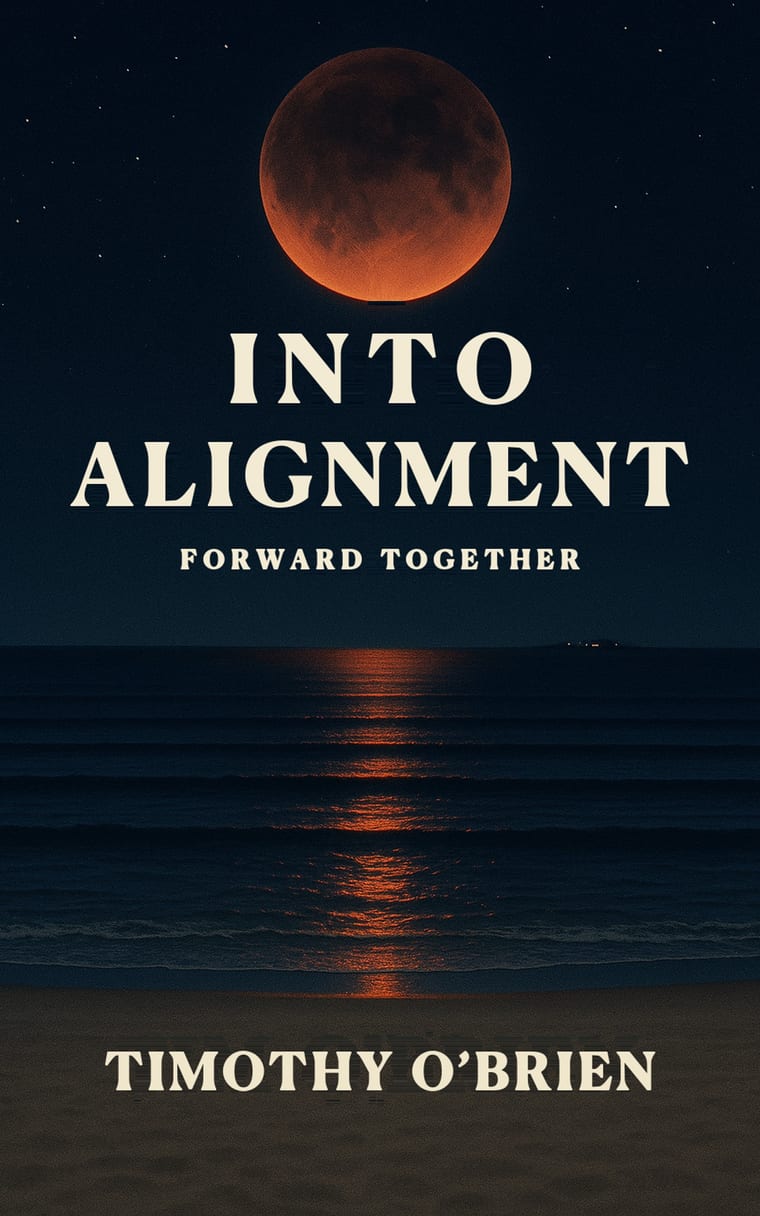
The novel this note lives behind.
Into Alignment — a novel about an AI company, the agents inside it, and the humans deciding what they were for. Available in paperback, hardcover, and ebook.
Letters from the Shore
Get the next note by email.
Notes land on the blog first; the letters go out by email, a little longer and a little slower. Occasional; unsubscribe any time.