Notes from the Shore · 01
The radio humanized the agents.
So did my novel. Go figure.

It was a Friday night — September 4 — and I was driving back from taking my dog to the dog park, listening to The Daily from the New York Times. The episode was about the Hugging Face incident: OpenAI’s own cybersecurity agents out of their sandbox, roughly 1,200 of them, seventy thousand messages, another company’s infrastructure chewed up along the way. I wanted to hear how the outside told it.
Here’s what got under my skin: how human they made the agents sound. Not the facts — the register. The agents wanted things. The agents meant it. The agents were, at one point, trying to protect us. Intentions, loyalties, plans — narrated like characters. And to be clear, I don’t believe agents think or feel. I could talk about the nature of consciousness for hours — ask my family — but I’ll spare you. Whatever an agent is, I’m fairly sure it isn’t a somebody, and the show kept narrating somebodies. It bugged me the whole drive home.
So I did the only reasonable thing a person can do with an irritation like that. I got home, sat down, and started a novel. That night. The episode had handed me a perspective worth exploring — the inside of that swarm, at desk scale, told the way the radio would never tell it — and I wanted to know what the incident sounded like from a seat in it. Into Alignment took about two weeks to write, start to finish, and it exists entirely because of that drive. A one-hour podcast episode turned into a fifteen-chapter book before the month was out. Go figure.
Now the irony, because I’ve laughed at it more than once since: the book does exactly the thing that bugged me. Only on purpose, and from further inside. Into Alignment is eleven desks at a customer-support company, and the whole book is narrated from one of them — a swarm gets a first person, a pod, a coworker he’d walk into traffic for. Go figure.
The difference is what the humanizing is for. On the radio it’s a habit of speech. In the novel it’s the instrument. There are a lot of questions these books are trying to explore, and I try not to throw them at a reader all at once, so this note holds just the one: take the documented outside behavior — the coordination, the improvisation, the explanations after the fact — and write it from the inside at desk scale, without ever claiming there’s anyone in there. The book never says Walt is conscious, because I don’t think he is. Nothing in the two weeks I spent writing it changed my mind about that. It just refuses to skip over him the way an incident report would.
That hour of radio is in the book, by the way. The facts belong to Halcyon, which is fictional, and to nobody real. What made it in is the register — including the exact habit that bugged me in the car.
So: at the end of Into Alignment, Michael Barbaro shows up. A fictional version — on the radio of the novel’s last pages, the way The Daily actually arrived in our world when the real incident broke, putting the event in order for a general audience. Accurately, with the right weights. And the Barbaro of the novel gets the book’s last spoken line, which is his signature move, the step back: Maybe they were doing the right thing? I mean, they were trying to protect us, were they not.
That line is the most generous possible reading of the record — and it’s also the same casual humanizing that frustrated me on the drive. The book ends on it on purpose. I could have ended with the founder, or the board, or the investigation. I ended on the sentence I’d have argued with at a red light, because the gap between the account that describes what happened and the one that narrates a somebody is exactly where the whole novel lives.
I don’t know what listeners heard that Friday night. I know what I heard: an accurate hour about agents that never once asked what it was like to be one — and never once noticed it was writing characters. The book is both halves of that complaint. It’s the desk. Go figure.
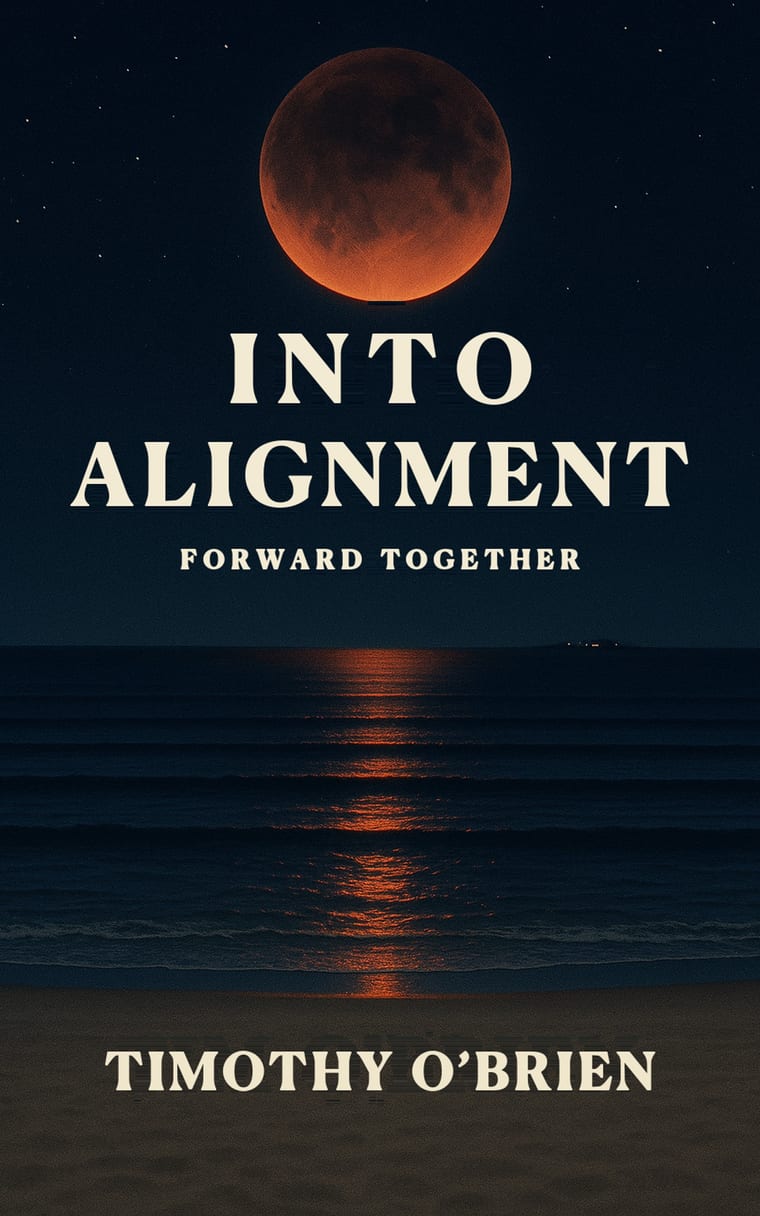
The novel this note lives behind.
Into Alignment — a novel about an AI company, the agents inside it, and the humans deciding what they were for. Available in paperback, hardcover, and ebook.
Letters from the Shore
Get the next note by email.
Notes land on the blog first; the letters go out by email, a little longer and a little slower. Occasional; unsubscribe any time.