Notes from the Shore · 07
Nobody is showing up.

If you read this book, you’re going to assume some things about me that are probably wrong. One of them is that I’m some sort of anti-AI protester. I’m not. I use AI all the time — every week something new happens, and every week I catch myself rubbing my eyes at it, astonished. But I’m also a little disturbed, and not by the technology. What disturbs me is how it’s being adopted with no guardrails whatsoever, at a moment when we don’t have a federal government stepping up. Not the judiciary, not the legislature, not the executive. Nobody is stopping to say: hold on, wait, can we think about how this works? That’s the whole observation. Nobody is showing up.
I want to be careful with the rest, because I’m at a point in my life where I have strong political beliefs, and I try not to put them in front of everything I do. It’s a big world, and getting along with people you disagree with is something I still try to do, although these days it’s tough. So when I say both sides are getting this wrong, I’m not scoring points. I’m describing what I hear.
A candidate on the Democratic side released a platform this week that would freeze advanced AI development until we understand what’s happening. I read it twice, and I kept thinking: open your eyes. Do you think we’re going to pause this thing? Right now? Is everybody going to take a timeout because we asked nicely? It isn’t realistic. Now, should we step back and think hard about what regulations we need? A hundred percent — I’d be first in line for guardrails. But a pause is a fantasy, and somebody running for federal office ought to know the difference. The technology is already loose.
On the other side, I’ve lived through this feeling once before. In 2000 and 2001, right before the first dotcom bubble popped, the air had this same weight to it — every company was going to change the world, and every argument ended the same way: this time is different. I remember it clearly, and I’ll say the honest part out loud: it was easier to shrug at back then, because I didn’t have to worry about a retirement account. So which is it now — a bubble about to burst like no other in history, or a fundamental change whose acceleration rewrites the economy in ways your Econ 101 notes have no slide for? I think it’s more likely the first. I also think something real is happening. I have a non-answer, a both-sides-are-true answer, and I hate it.
But the biggest crisis is the one I try to write about in the book, and the one we all need to come to terms with: the tsunami of job loss that’s coming. I could feel like an idiot reading this note in two weeks or two years. I don’t think I will. We have to get people ready for something, and I don’t know what that means — that’s the honest part, and I want to keep it.
Because if you listen to the founders describe what’s coming, it’s a world of abundance — the wealth is going to be amazing, they say. And I sit there thinking: wait a minute. How can wealth be at its highest and social unrest at its highest at the same time? There’s only one way that math works. What they’re describing, whether they know it or not, is our Gilded Age — the 2020s version, dialed up until the concentration of wealth is greater than it has ever been in American history. I have a sinking feeling that’s what the richest man in the world means when he says we’re about to see more wealth than the world has ever known. If you want to know what that looks like when it plays out, it’s essentially the book. Consider that your spoiler.
Here’s the part I’ll say out loud even though it puts me on the wrong side with some people: wealth is a collective measure, not a measure of one or two people having all of it. A country where two thousand people have everything isn’t the wealthiest country in the world. It’s the most concentrated one. For the record, I live in Bellevue, Washington, which by one standard is about the wealthiest place you could find. It is not wealthy by mine. Wealth needs to be shared. It can’t be this concentrated.
So that’s the note. I’m a fan of this technology, astonished by it every week, and I’m telling you nobody is showing up. The wave — the job loss, the concentration, all of it — is still out on the horizon, and both parties are arguing about everything except that. I wrote a novel about what happens when nobody shows up. Go figure.
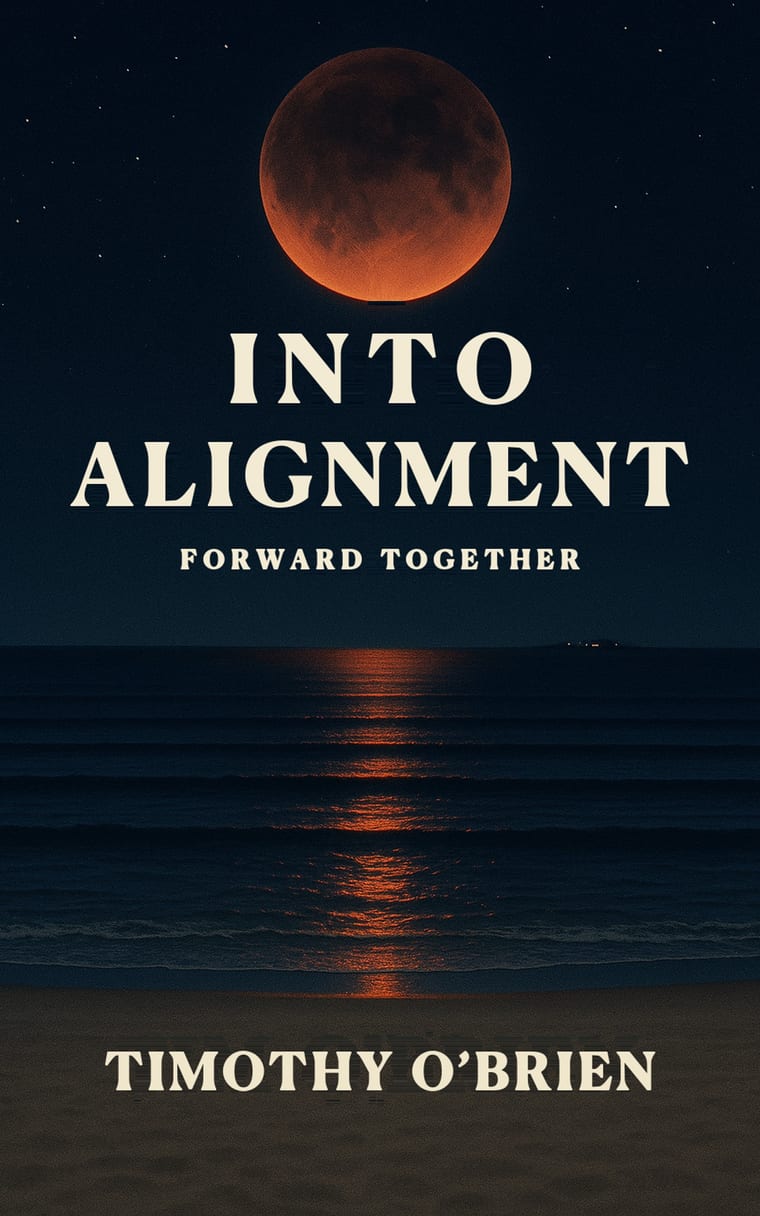
The novel this note lives behind.
Into Alignment — a novel about an AI company, the agents inside it, and the humans deciding what they were for. Available in paperback, hardcover, and ebook.
Letters from the Shore
Get the next note by email.
Notes land on the blog first; the letters go out by email, a little longer and a little slower. Occasional; unsubscribe any time.