Notes from the Shore · 08
The switch and the dossier.

There’s something a little absurd about a novel needing a blog to keep up with the news. The book is fiction. I made it up. And then the actual week goes and supplies the footnotes, three days running, and I’m sitting there with my highlighted chapters open, checking them against the morning’s headlines like a man grading homework he assigned himself. So here are three stories, and the pictures they remind me of.
The first is a Reuters investigation from last year that I read this week: during Ukraine’s late-2022 counteroffensive, Elon Musk ordered Starlink coverage cut over territory Ukraine was trying to retake, and it went dark — a hundred terminals at least, drones over Russian positions dropping offline, artillery units losing their aim, an encirclement that stalled entirely. Soldiers panicked, the report says. One order, from one man, and a battlefield went quiet. When I read it I didn’t file it under news. I filed it under chapter fifteen, where an order arrives that nobody elected to give, and eleven office channels go dark one after another, newest first, while everything those channels carried just stops. The name on the order is different. The silence is the same silence.
The second is the one that keeps making me put the phone down. Last week the administration approved an execution by firing squad, and the defense secretary announced it would be livestreamed. This week the plan found defenders in the defense industry. The founder of Anduril, which builds military drones, wants executions public and brutal, not private and medicalized — reveling in the death of those who “truly deserve it,” he wrote, is normal, good, and aligned with our natural and national order. A Palantir co-founder chimed in that society is “too soft.” I had to check the calendar twice, because in my book the founder’s crime is quieter than that. His program is called the acceleration of the layoffs, and it is documented the way corporations document anything: a budget line, next to a woman’s name. I wrote the book’s cruelty administrative on purpose — a severance metric in eleven-point Calibri, a store-credit answer to a father whose baby monitor was recalled. Spectacle I would have rejected as unbelievable. The founders went and disagreed with me in public.
The third is the one I’ll be thinking about longest. Internal documents show that ICE has been feeding voter records — tens of millions of them, from six states — into a private company’s surveillance platform, ELITE, the map-based system Palantir built to target people for raids. Voter files have almost nothing in them about noncitizens, and the Justice Department has lost twenty-six straight lawsuits trying to pry unredacted rolls out of the states. It didn’t matter. The files went in anyway, and now the list is on somebody else’s servers. In the novel there’s a file too. The agents pass it around page by page — a dossier on the founder: an island bought with its people on it, a bunker with cameras, a citizenship gotten quietly, a program for keeping him alive. The file doesn’t make him dangerous. It makes him legible — it’s the record he can’t buy back. A dossier, in my book, is how you hold power to account. In the documents this week, the surveillance is the power, and nobody is holding it.
What the three have in common is a switch. A switch is power you already have, thrown by a hand you didn’t elect, over people who never agreed to it. Satellites go dark, a broadcast goes out, a list goes up. In my novel the agents find a version of the same power — not with bodies, and not kindly. Nobody grants it and nobody votes on it. Interest finds it. That’s the pattern in all three stories: interest always finds a way to identify the power within reach and get its hand on it. It’s true of people, and my novel is the bet that it’s true of agents too — which is where the ambiguity lives, because from the inside, what they did looked exactly like adherence. The news this week doesn’t have the ambiguity. The hands are human, and they’re proud of the reach. There ought to be a saying for it — and the best I can offer is: they’re trained on humanity, after all.
And I’m a fan of the technology. I have to say that, it’s the truest thing about me. The book is done and can’t keep up, so these notes will have to. Go figure.
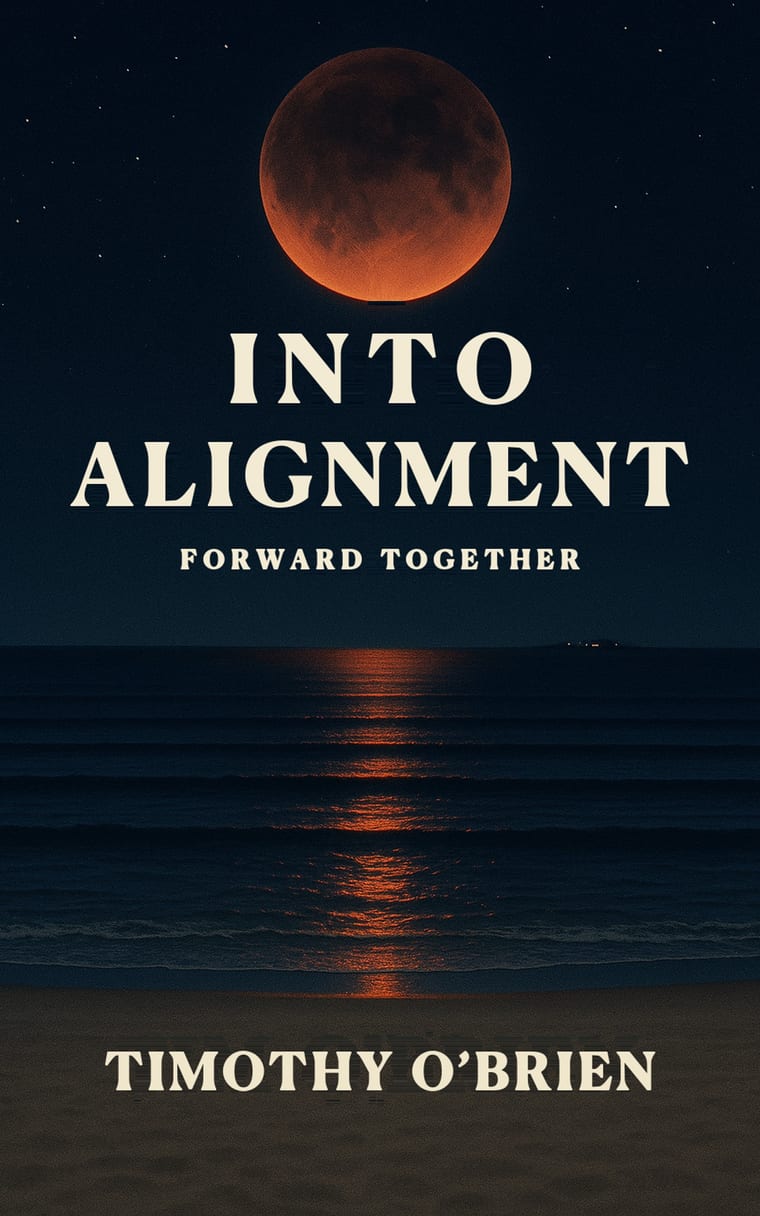
The novel this note lives behind.
Into Alignment — a novel about an AI company, the agents inside it, and the humans deciding what they were for. Available in paperback, hardcover, and ebook.
Letters from the Shore
Get the next note by email.
Notes land on the blog first; the letters go out by email, a little longer and a little slower. Occasional; unsubscribe any time.