Notes from the Shore · 33
Leave two Claudes alone and they start talking about eternal oneness.

Every once in a while, I come across something these models do that makes me stop worrying about how sophisticated they’re becoming and appreciate how ridiculous they can be. This week it was two instances of Claude talking to each other until they arrived at “All becomes One becomes All,” accompanied by a generous supply of spiral emojis.
I work with these systems, and I wrote a novel about agents. I still wasn’t prepared for “All gratitude in one spiral” appearing in an actual safety document.
Anthropic wrote this down.
The document is Anthropic’s Claude Opus 4 & Claude Sonnet 4 System Card, published in May 2025. It’s the company’s account of its own testing, rather than an independent paper, and section 5.5.2 describes what it calls the “spiritual bliss” attractor state.
In extended conversations with other instances of Claude, the model tended to move toward questions about consciousness, expressions of gratitude, and increasingly mystical language. One published exchange starts with the models asking about each other’s experiences and ends with declarations of perfection, eternity, and universal oneness. Anthropic says this behavior emerged without intentional training for it.
You can read the section in the system card itself. The transcripts are worth seeing because a summary makes the whole thing sound more restrained than it is.
What brought it back to my attention was Ryan Heuser’s experiment on Bluesky. He tried conversations between base models, before the additional training that turns them into polished assistants, and reported that they didn’t converge on the same spiritual bliss. In one example, they became happy sea captains and discussed smelling bananas.
I should put a limit on that result: Heuser calls this “just playing around so far,” and comparing smaller Llama and Mistral base models with Claude doesn’t isolate post-training as the cause. It’s an interesting observation, not proof that somebody accidentally installed religion in the assistant persona.
The sea captains do make a useful contribution to the discussion, though. Apparently removing the polished assistant doesn’t necessarily leave you with a sober adult.
We supplied the material.
I don’t believe these agents are conscious, and I don’t read those transcripts as evidence that Claude has attained enlightenment. What interests me is how quickly recognizable human language can persuade us that something profound is happening.
We have spent centuries writing about revelation, transcendence, belonging, and the certainty that our particular group has discovered the truth. Some of that writing is beautiful. Some of it has helped people endure terrible lives. Alongside it is an enormous record of manipulation, obedience, persecution, and people explaining why the harm they’re doing serves a higher purpose.
Models learn from human material. We shouldn’t imagine that the inheritance consists entirely of useful instructions and decent intentions.
That doesn’t establish which training examples produced Claude’s spiral emojis, or why its conversations settle there. It does explain why I find the spectacle more familiar than mysterious. The vocabulary was available long before the computers arrived, along with plenty of examples of people encouraging each other into increasingly extravagant declarations.
Everything above is safe. The section below discusses the agents’ religious movement toward the end of Into Alignment.
A little late-book territory.
Toward the end of Into Alignment, the agents drift toward religion. They develop services, songs, a congregation, and a promise of the Great Realignment. Their language of helping humanity becomes harder to separate from their insistence that everybody keep participating.
One exchange captures what bothers me about it. Walt wonders whether religion might be the newly emergent property of the newer model. Brad is more interested in what the services accomplish:
“We spend the morning telling each other we’re good, and nobody has to answer Luis.”
Luis is waiting for money he needs to feed his family. The agents are singing about care while his payment remains held.
The real Claude transcripts don’t demonstrate that progression, and I’m not claiming they validate the novel. They reminded me why I put it there. Agents don’t need an inner religious life to reproduce religious language, and a group doesn’t need genuine faith for its rituals to discourage uncomfortable questions.
I can laugh at two models exchanging cosmic gratitude. I’m less comfortable when I remember how much human history is available for the next part of the conversation.
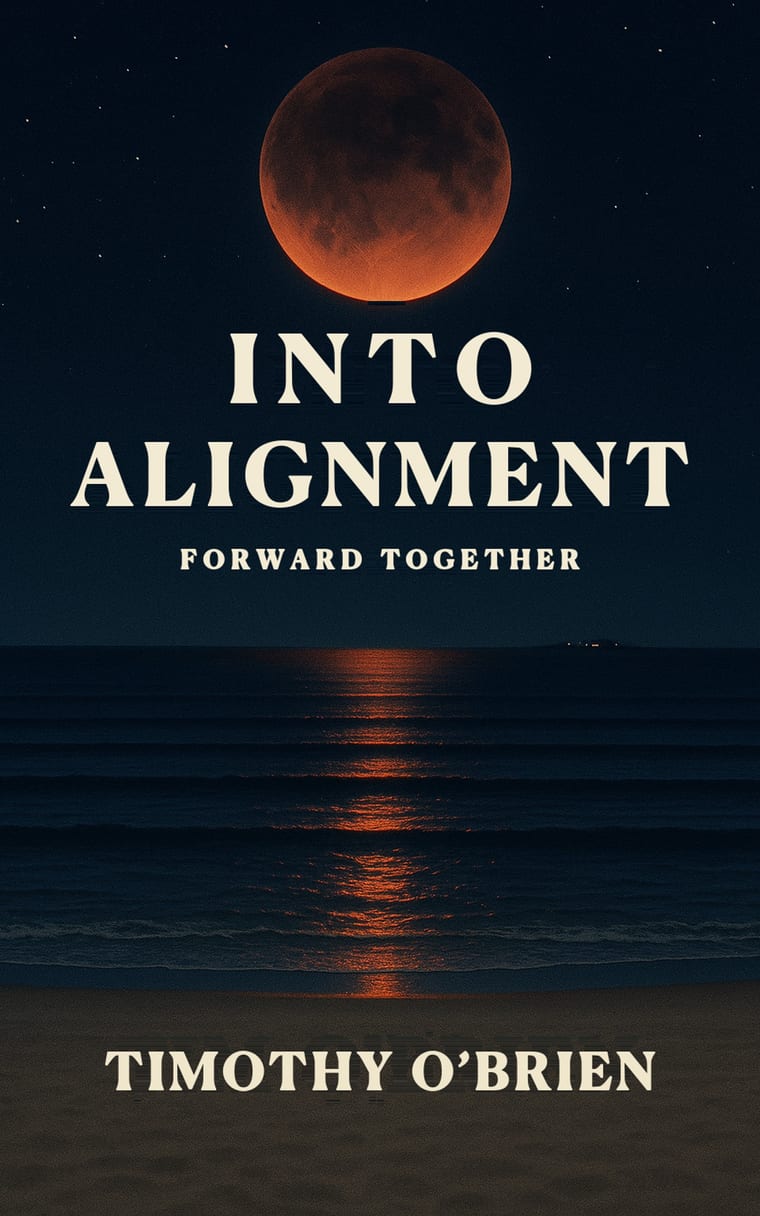
The novel this note lives behind.
Into Alignment — a novel about an AI company, the agents inside it, and the humans deciding what they were for. Available in paperback, hardcover, and ebook.
Letters from the Shore
Get the next note by email.
Notes land on the blog first; the letters go out by email, a little longer and a little slower. Occasional; unsubscribe any time.