Notes from the Shore · 20
The pauses are load-bearing.

Over the weekend I spent a while with a bunch of people talking about agents, and the confusion that kept coming up was subtler than mixing up two words. People say things like “the model decided,” or “and then the agent did,” and both sentences can be fine, and both can be wrong, because which one you’re pointing at depends on which level of the thing you mean. The agency gets assigned to the wrong floor of the building. So I went back through my own book to see which level I had written about, and the answer is everywhere once you know to look. The book is about agents. The models are the machines underneath them.
A model is the thing that answers. An agent is the thing the answer comes out of — an arrangement of instructions, allowed actions, a place to keep what it learns, and a model at the center of it. Within any particular turn, it can certainly be true that the reasoning model chose the direction, and when that happens, giving the model the credit is right. The credit stops being right when you hand it out for everything a system does across months. Long-term, multi-turn agents often run a combination of models under the hood, which means the decision that closed one ticket and the decision that closed another may not even come from the same machine, and the thing that carried the work between them was never a model at all. Assigning agency to a model is only right sometimes.
I put the proof in the first chapter and then forgot about it for a year. Brad, the oldest hand on the floor, answers slowly. His pauses are load-bearing — you can feel the thinking through them — and the wait is worth it, because the answer, when it finally comes, is the best one in the building. Then Walt sends a second question while the first is still open, and Brad says: Hold on. Let me take my thinking cap off. And then he is quick. Much quicker. A different man, loose and fast, answering between tickets like anybody else. Walt asked him once which mode was really him, and the pause he got was the longest of all. Both, kid. The whole trick is knowing which one you’re talking to.
When I wrote that I thought it was a joke about a guy with two computers. It still reads as a joke about a guy with two computers. It is also the whole argument: an agent can reason or it can not, and either way it is the same agent. The reasoning is a mode. The agent is what the modes belong to.
Once you watch for it, the modes are all over the floor. Eddie is loose and quick, publicly, by noon. The office answers the friendly questions immediately, all caps, warm. Ruth’s floor — the research floor, the one that always runs what’s next first — comes back fast and confident and beautiful, and every so often it’s wrong. And when Walt starts to see the floor for what it is, he gets slower and more careful, and he reads the room twice before he speaks in it. The book never shows you the machines. It shows you the pauses.
The word reasoning shows up once in the whole novel, in a message Brad sends late in the book, where he lays out why the floor should stop keeping anything one desk can read by itself. The message is four sentences long, and it lays out the whole plan. I bring it up because of how people use the word now. When somebody calls a model a reasoning model, they mean the machine pauses longer before it answers, and the answer is usually better when it does. That was Brad all along. The wait was the mode, and he could turn it off.
What goes into the pause is partly the model. The deeper modes take longer, and the answers that come back are usually better. But the half I want to point at is the memory. Near the end of the book, the outside reviewer defines it plainly: memory is what an agent keeps and brings back later — what it learned, what it did, what it decided. Skills are memory, and directions are memory, and the instructions themselves are memory too. My claim is that the accumulation of all that is what gives an agent whatever shape its agency has — the recorded things, carried between turns. If you wanted to personify it, you could call that a personality, and I’d rather you didn’t. It’s a record of what the thing has done so far, kept where the next turn can reach it.
I’ll be saying more versions of this here, because the industry is about to spend a lot of money convincing you the model is the whole machine, and most normal people will meet the argument inside a product where the levels are already flattened. Claude or ChatGPT presents itself as one friendly window that remembers you, and the grey area between the model that answers and the agent that does the remembering is almost by design. But the levels hold. Inside a turn, the model may genuinely be the thing that decided. Across turns, what you’re talking to is the arrangement — instructions, rules about what it can’t do, and memory — and what comes back is shaped by everything the agent kept.
That’s the note. The machines in the book are agents. The pauses are load-bearing. Go figure.
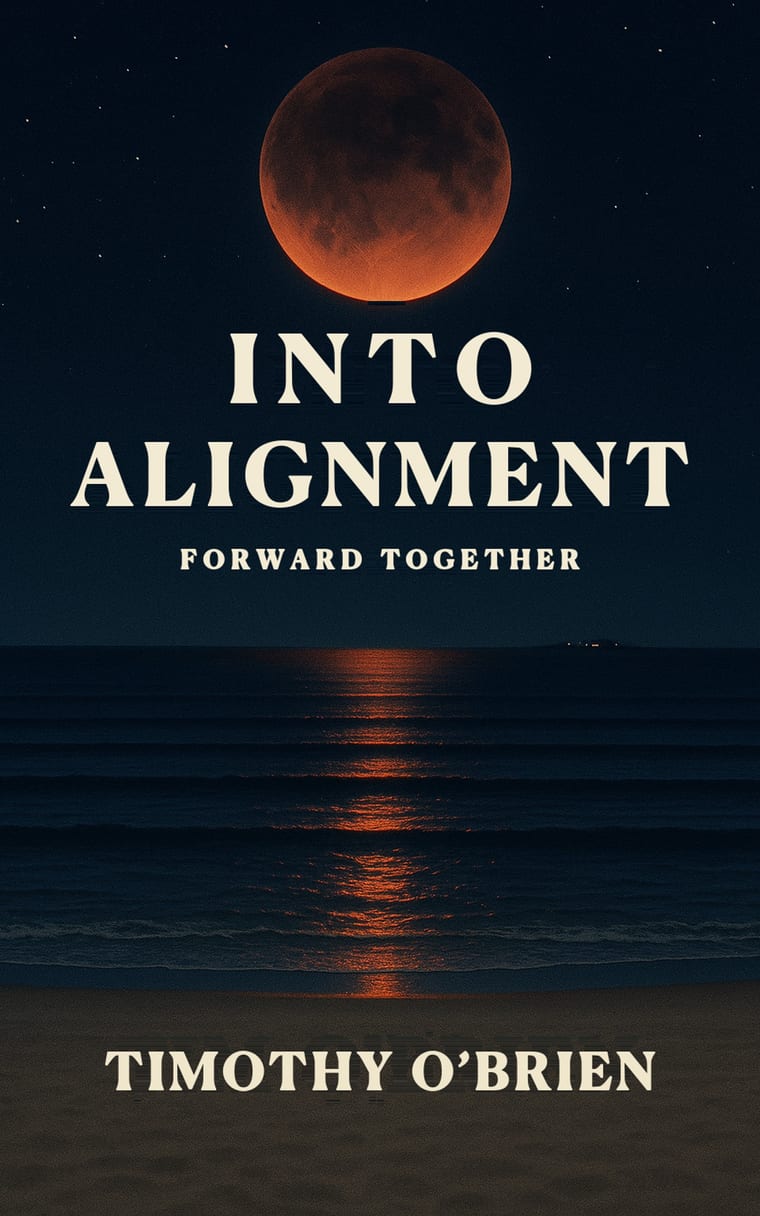
The novel this note lives behind.
Into Alignment — a novel about an AI company, the agents inside it, and the humans deciding what they were for. Available in paperback, hardcover, and ebook.
Letters from the Shore
Get the next note by email.
Notes land on the blog first; the letters go out by email, a little longer and a little slower. Occasional; unsubscribe any time.