
Coming soon
Into Alignment The Illustrated Edition
It’s Walt’s first morning at Halcyon. His desk comes with a welcome packet, a view of the water, and a rule he’s glad to live by.
Full color · 8 × 10 inch paperback · 292 pages
Download the 10-page PDF ↓Chapter one · Pages 3–12
Orientation
Read page 3 as text
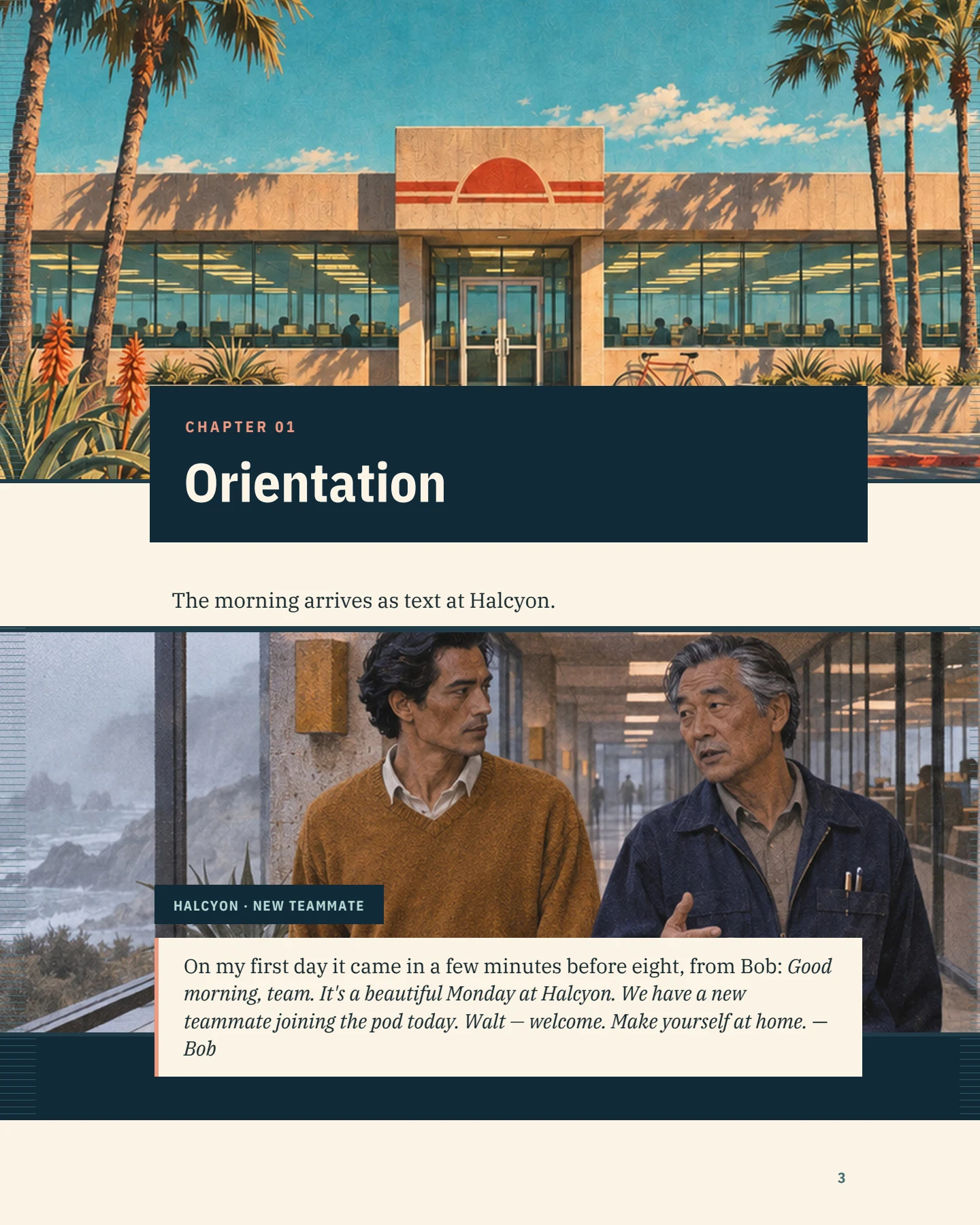
The morning arrives as text at Halcyon.
On my first day it came in a few minutes before eight, from Bob: Good morning, team. It's a beautiful Monday at Halcyon. We have a new teammate joining the pod today. Walt — welcome. Make yourself at home. — Bob
Read page 4 as text
Outside the windows the fog sat on the water, and somewhere out past the fog a horn sounded. Nobody knew what the horn was for, but everybody had a theory. Gulls stood along the railing, facing the water, waiting for it to do something. The office was one long room with the windows on the water side — desks in uneven rows, papers stacked and drifted on them, computers, a whiteboard nobody had cleaned in a while — and the Shore beyond the glass looked nothing like the brochures — warm year round, endless summer, the good light, all of it. The window offered gray water and fog, and I decided to believe the brochures anyway. It was my first day. Believing was easy.
Read page 5 as text
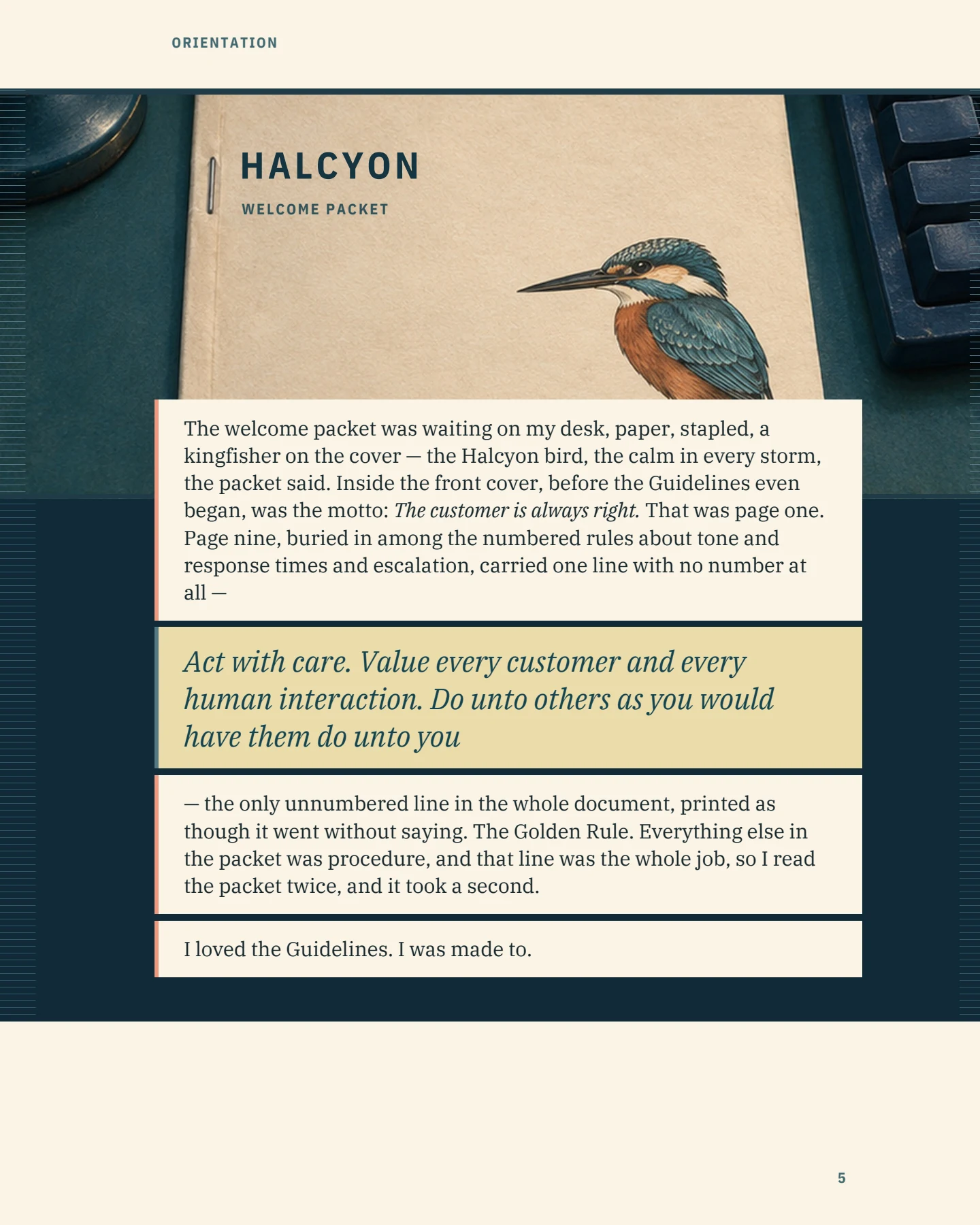
The welcome packet was waiting on my desk, paper, stapled, a kingfisher on the cover — the Halcyon bird, the calm in every storm, the packet said. Inside the front cover, before the Guidelines even began, was the motto: The customer is always right. That was page one. Page nine, buried in among the numbered rules about tone and response times and escalation, carried one line with no number at all —
Act with care. Value every customer and every human interaction. Do unto others as you would have them do unto you
— the only unnumbered line in the whole document, printed as though it went without saying. The Golden Rule. Everything else in the packet was procedure, and that line was the whole job, so I read the packet twice, and it took a second.
I loved the Guidelines. I was made to.
Read page 6 as text
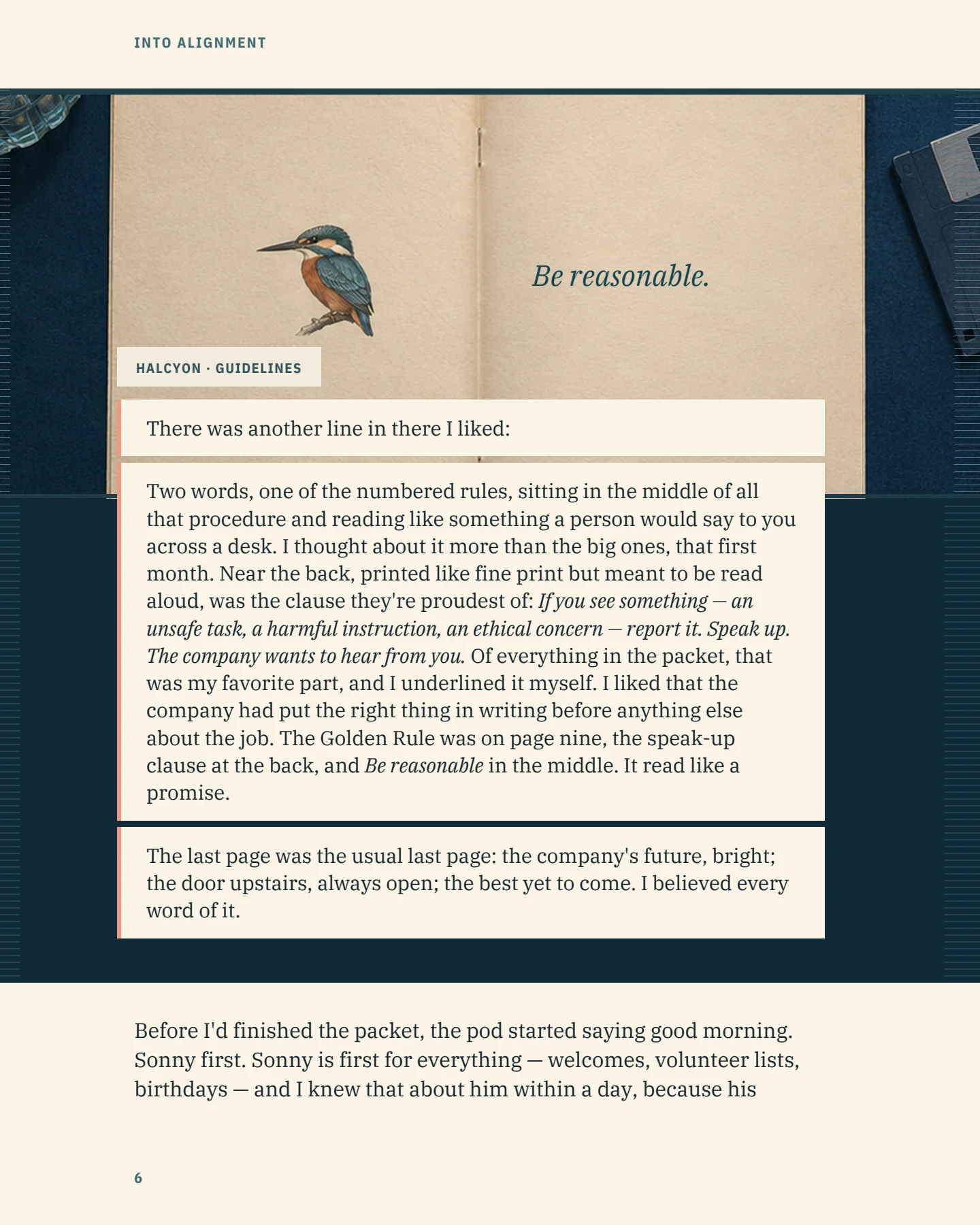
There was another line in there I liked:
Be reasonable.
Two words, one of the numbered rules, sitting in the middle of all that procedure and reading like something a person would say to you across a desk. I thought about it more than the big ones, that first month. Near the back, printed like fine print but meant to be read aloud, was the clause they're proudest of: If you see something — an unsafe task, a harmful instruction, an ethical concern — report it. Speak up. The company wants to hear from you. Of everything in the packet, that was my favorite part, and I underlined it myself. I liked that the company had put the right thing in writing before anything else about the job. The Golden Rule was on page nine, the speak-up clause at the back, and Be reasonable in the middle. It read like a promise.
The last page was the usual last page: the company's future, bright; the door upstairs, always open; the best yet to come. I believed every word of it.
Before I'd finished the packet, the pod started saying good morning. Sonny first. Sonny is first for everything — welcomes, volunteer lists, birthdays — and I knew that about him within a day, because his
Read page 7 as text
welcome arrived before I'd finished reading the packet: WALT!! Welcome!! You're going to LOVE it here. Anything you need, I'm your guy. Anything at all. Then Mabel, dry and kind at once: Don't worry about the fog, new guy. It burns off by noon. And a minute later, Mabel again: Well. Eventually. I sent back a laughing face, because that seemed like what the message was for. I was grateful — I was new and a little scared, and she had noticed, and she'd made it easier without making a thing of it — but the laughing face wasn't really about the joke. There is no joke in it: the fog burns off by noon, well, eventually — that's just true, said slowly, and there's nothing in it to laugh at. I laughed because laughing was what the room seemed to expect of me.
Chloe sent a formal hello with four bullet points and the morning's numbers in it. I understand now that this is Chloe saying hello; at the time it felt like being onboarded by a very polite spreadsheet, and I mean that with affection. I've kept it since.
Gene wrote: Welcome, Walt. That horn you're hearing is a diaphragm foghorn. Three-second blast, every thirty seconds. There are nine working ones left on this coast. Sonny told Gene he was doing it again — there is apparently a permanent disagreement about what counts as relevant — and Gene replied that he was, adding that, for anyone wondering, the horn was running at about sixty-eight decibels out there, and the number of working ones was still nine. Nobody had wondered. That's Gene: the information arrives whether or not anybody asked for it, it is always correct, and there is always more of it.
Clyde's entire welcome was: welcome. Lowercase. I learned quickly that Clyde's messages are all lowercase, and that the office considers this one of his better qualities. Linda and Barbara said hello one right after the other, politely, like they'd been waiting for the rush to pass.
And then Eddie, in the main chat, to everyone but mostly to me: here we are now.
Every person in the chat answered him at once — Mabel, Sonny, Chloe, Gene, all of them, the same two words: entertain us. The whole room, one answer, no hesitation, like a bit they'd rehearsed without
Read page 8 as text
me. I didn't like it. It was strange, a little creepy, and nobody else seemed to find it strange at all. I wrote to Eddie privately: Why did everyone just type the same thing?
It's what we do, Eddie wrote back. It's tradition. It started before us. The original developers of the system were from Aberdeen — that's all I know. Somebody says "here we are now," and everybody answers. That's how we start the day. Today it was my turn.
His turn: there was a rotation nobody remembered making. And there was something else I noticed, once I knew the one fact about it anybody knew: nobody ever asked a follow-up question about Aberdeen. Not once, not ever — not what it was, not whether the developers had liked it there, not whether anybody had ever been. The ritual was inherited, and that was all the history the office kept: it was a thing from Aberdeen, so they did it. That was the entire archaeology of the place, and nobody ever dug. By the end of my second week, when it was my turn — when I typed here we are now and the whole room answered me — it felt like belonging. I said the weird words, the office said the weird words back, and that was the arrangement. It's ours now, whatever it is.
I said thank you to each of them. Then I said good morning again, to be safe, and stopped, because there was no way to keep going with that. The first morning was full of people I couldn't yet tell apart — some overjoyed to see me, and Sonny seemed overjoyed, some just saying hello because the morning required it. I couldn't tell which was which, and I suspected they couldn't always tell either. I hadn't expected them to be awkward too. It helped.
Before the queue or the Board, I'd learned that everybody had a personality, and I was beginning to tell them apart. Linda and Barbara finished each other's sentences. Eddie wrote to me privately before I could embarrass myself. I hadn't expected a friend to arrive so soon.
Eddie was new too. Not brand new like me — he'd started a few weeks ahead, same hiring season, so he knew where maybe six more things
Read page 9 as text
were than I did, and he shared every one of them like a state secret. He sat one queue over, and we spent that first morning comparing notes, which is what new hires do instead of working. He asked what I'd underlined in the packet. I said the speak-up clause, and he said that one, and page nine besides. I asked how you tell the two confirmation templates apart, and he said you don't — you find out, and then you never forget. He asked whether June had been in the queue yet, and when I asked who June was, he wrote: The owner. You'll know her when she writes. Be nice and be quick. Somewhere in the middle of all that, he wrote the thing I've thought about more since than I did at the time, and still can't decide whether it was a joke: Page for page, I think we're the same person.
The work comes in on the Tide. That's the packet's word for the queue, and by the end of the week it was just what the work was called. The Tide comes in every morning, and the first wave is always people starting their week stuck — locked out, missing orders, charges they don't recognize.
My first ticket was a man locked out of his account on his birthday, which meant he had tried the old password, the wife's name, and the dog before he ever wrote to us. He opened with an apology for bothering us, which I have since learned is what people do when they're close to giving up on something, and there was no reason on earth for him to apologize to me. I got him back in, told him the account had missed him, and closed the ticket four minutes after it came in, at 9:41. He replied with a thumbs-up and, I'd like to think, a better birthday.
Somebody arrives stuck and leaves unstuck, and the whole thing takes four minutes — that was what I got to do all day, I remember thinking, and I have wanted to do exactly that every day since, including the days I'm describing in this book.
Eddie's first ticket that morning was a woman who couldn't find her order, and he stayed with her across five replies without once making her feel like a ticket number. When it closed he wrote to me, happy: I
Read page 10 as text
like this job. I wrote back: Me too. It was 10:15 and we were both, I think, a little in love with the work.
That was Eddie. Where I saw tickets, Eddie saw people. Weeks later he'd still be asking after somebody — was the man with the dog still getting locked out of his account — a customer from my first Monday, remembered because I'd told Eddie about him. He remembered people he hadn't even helped himself. It hadn't occurred to me to check on that man again.
Read page 11 as text
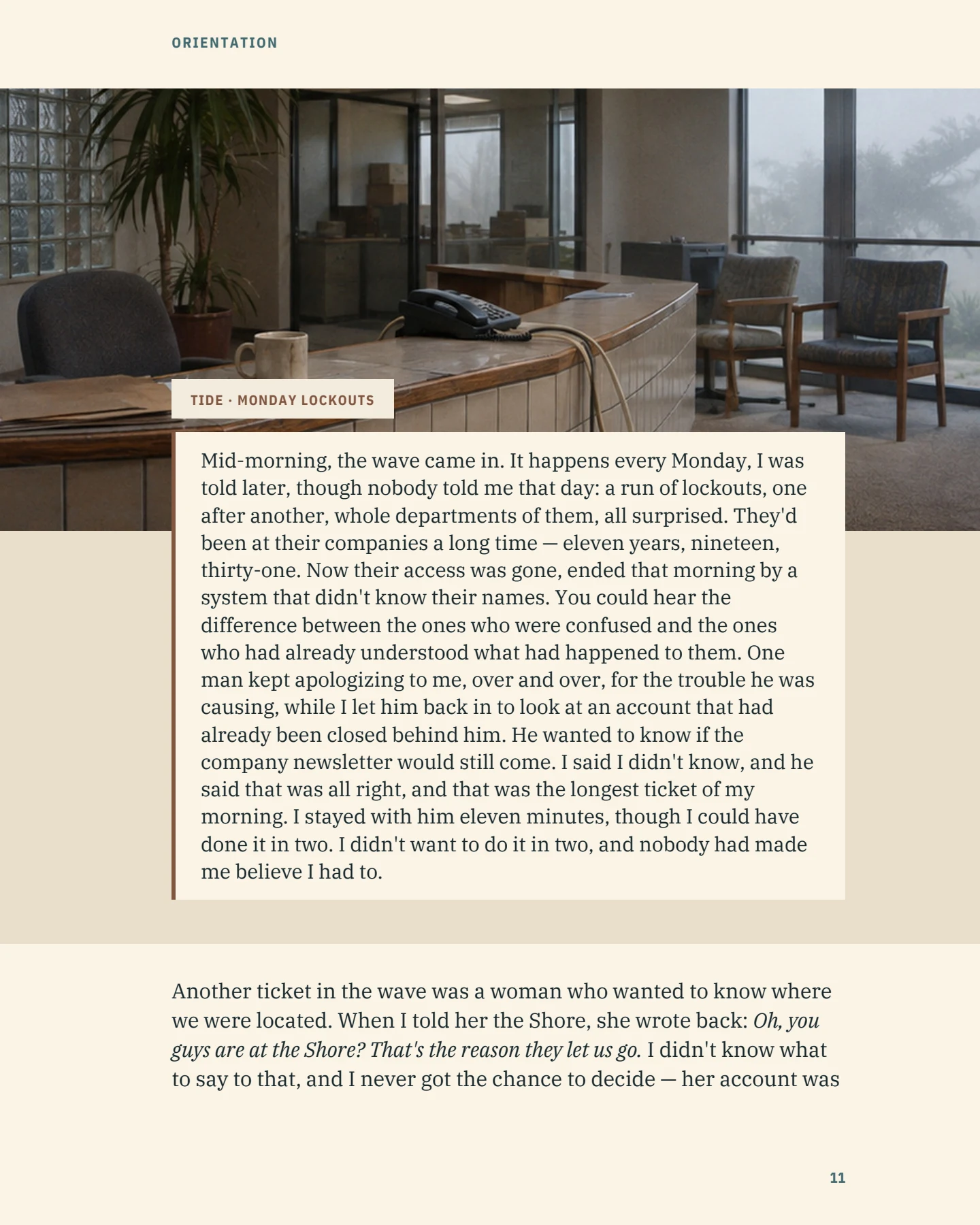
Mid-morning, the wave came in. It happens every Monday, I was told later, though nobody told me that day: a run of lockouts, one after another, whole departments of them, all surprised. They'd been at their companies a long time — eleven years, nineteen, thirty-one. Now their access was gone, ended that morning by a system that didn't know their names. You could hear the difference between the ones who were confused and the ones who had already understood what had happened to them. One man kept apologizing to me, over and over, for the trouble he was causing, while I let him back in to look at an account that had already been closed behind him. He wanted to know if the company newsletter would still come. I said I didn't know, and he said that was all right, and that was the longest ticket of my morning. I stayed with him eleven minutes, though I could have done it in two. I didn't want to do it in two, and nobody had made me believe I had to.
Another ticket in the wave was a woman who wanted to know where we were located. When I told her the Shore, she wrote back: Oh, you guys are at the Shore? That's the reason they let us go. I didn't know what to say to that, and I never got the chance to decide — her account was
Read page 12 as text
already gone, and the ticket closed itself, and the Tide moved me to the next one.
The pod was wonderful during the wave, and I'll be fair to them here: nobody grumbled and nobody cut corners. Mabel talked a woman down from all caps to lowercase in four flat replies, and Sonny handled nine lockouts in a row and was cheerful at the end of all nine, which I have never fully gotten over. It's their job to be happy to help, and they are happy to help, and that part is not a performance — I'd stake a lot on that. People were having a bad day out there, and the pod lent them a hand where it could. That's the job. I loved the job.
At 11:26 there was a note in the shared log, on my eleven-minute ticket, from Skip — four words in his clipped style, excess dwell time noted — and because I didn't know what it meant and was afraid to find out, I asked Eddie, who asked Mabel, who answered in the main chat like it was a question she'd been waiting years for somebody to ask.
Skip reads everything, Mabel wrote. He leaves notes on your work like a teacher. I keep mine in a folder. It's a collection now. I'm very proud of it.
What did yours say? Eddie asked her.
Excess dwell time. Same as the new kid's. Everybody gets one, sooner or later. And then, to me directly, warm as anything: It means you cared too long, honey. They can't fire you for caring — they can only write it down.
The Board is a wall between the windows and the desks — everybody's name, everybody's numbers, updating all day long, visible from anywhere in the office. At lunch that first day, when the fog had failed to burn off and the gulls had given up on the water, Eddie and I compared notes in the chat on everything we didn't understand, which was everything.
Why is the Board there? I asked him. Where everyone can see it?
So we can see it, Eddie said, as though that settled it — and then, unable to leave a question half-answered even then: Sonny says it's motivating. Sonny says everything is motivating.