Notes from the Shore · 40
The Threshold: does proof cadence prove the AI safety rumor?
OpenAI and Anthropic each credit an unnamed internal model with a major proof. The cadence of the results might make the too-dangerous-to-release rumor look true.

In late October, OpenAI and Anthropic each released a paper written by an AI model claiming to refute the Exponential Time Hypothesis — a 25-year-old conjecture that sits underneath half of modern algorithm theory. Both proofs passed the Lean proof checker. Ryan Williams at MIT, Russell Impagliazzo and Ramamohan Paturi at UC San Diego — the two men who originally proposed ETH — are now leading the independent check. Nobody has signed off yet. Greg Brockman put it plainly: “p still probably doesn’t equal np.”
That was the warm-up. This week it got stranger.
Two internal models, one week apart
On November 23, Anthropic posted a proof claim that VP is not equal to VNP — the algebraic cousin of P vs NP, posed by Leslie Valiant in 1979. It came from what the company calls an internal model. Ryan Williams posted quick reactions within a day: “I’m happy to see a major lower bound proved with AI! That is extremely exciting,” while cautioning that algebraic circuit lower bounds draw on “a vast algebraic literature that AI could draw from” and don’t yet update him on P/NP itself.
Two days later, OpenAI dropped a 111-page proof that the matrix multiplication exponent is exactly 9/4. Deedy Das, a partner at Menlo Ventures, laid out the history: Strassen got below 3 in 1969, and from 1990 to August 2026 humanity shaved off 0.005. Then November 2026: 2.25, both directions, supposedly settled. His summary line is the right one — “Wild to see things we were taught in university be changed right before our very eyes.”
Anthropic’s VP/VNP result came from an “internal model.” OpenAI’s matrix result came from another “internal model.” Neither model has a name. Nobody outside the labs has run either one. Two competing companies, two unnamed internal systems, each quietly handing over decade-old open problems in the same two weeks. That’s an odd coincidence, or it’s a pattern, and we don’t get to see which.
The rumor
The “frontier model is too dangerous to release” rumor isn’t new — every capability jump since 2023 has produced one. What’s new is the texture. Emanuele Viola’s CACM retrospective describes what actually happened this fall: rumors that OpenAI was systematically attacking all the major open problems in math and CS and “solving a large fraction of them,” a rumored October 6 release date, a flood of human researchers rushing partial results onto the web to stake claims before the dump landed. When October 6 came, the dump contained “solutions to hundreds of major mathematical problems, many of which had stood for decades and some for over a century.”
The proofs seemed to originate from an alien mind.
That last line is Viola’s, not a critic’s. He’s a computer scientist at Illinois who spent the fall watching the field he works in get rewritten from the inside.
The DIY layer
Meanwhile the crowdsourcing arrived. pequalnp.com runs a live fleet of AI coding agents — Claude Code, Cursor, Codex, Gemini CLI — attacking P vs NP itself, one Lean-verified lemma at a time, in public, with a graveyard of refuted approaches. The site’s own verdict is honest: “open, being worked on now.” Hacker News is mostly skeptical and the lemmas are small. But the infrastructure is the story: machine-checked proofs mean an anonymous agent’s work either checks or it doesn’t, and anyone on earth can point their coding agent at the problem tonight. Lean has turned proof-verification into something a swarm can do. That’s the DIY part, and it didn’t exist two years ago.
So are we on the verge?
Honest answer: the published results don’t settle P vs NP, and the people whose judgment I’d trust — Williams chief among them — are saying exactly that, in public, on the record. A subexponential 3-SAT algorithm is not a polynomial one. VP ≠ VNP is not P ≠ NP.
But here’s the question I can’t shake. If the labs are watching their internal models clear decade-old open problems weekly, the gap between what they’re seeing internally and what gets published could be exactly where the panic lives. Mustafa Suleyman, Microsoft’s AI CEO, chimed in this morning: “We are crossing a threshold. Safety and alignment work is the only thing that matters.” No elaboration. He does not post like that over a matrix multiplication result, no matter how good it is.
I don’t believe these models understand what they’re proving. A lot of training, a little bit of math, and some chance — deeper than that, but not consciousness, not intent. The proofs still have to survive human checking, and ETH hasn’t been verified by anyone yet. What I’d say is this: the pace of the verifiable results is real, and the people closest to the internal systems have started talking like men who’ve seen something. Whether it’s a breakthrough or excitement about nothing, we’ll find out the way we always do — one checked lemma at a time.
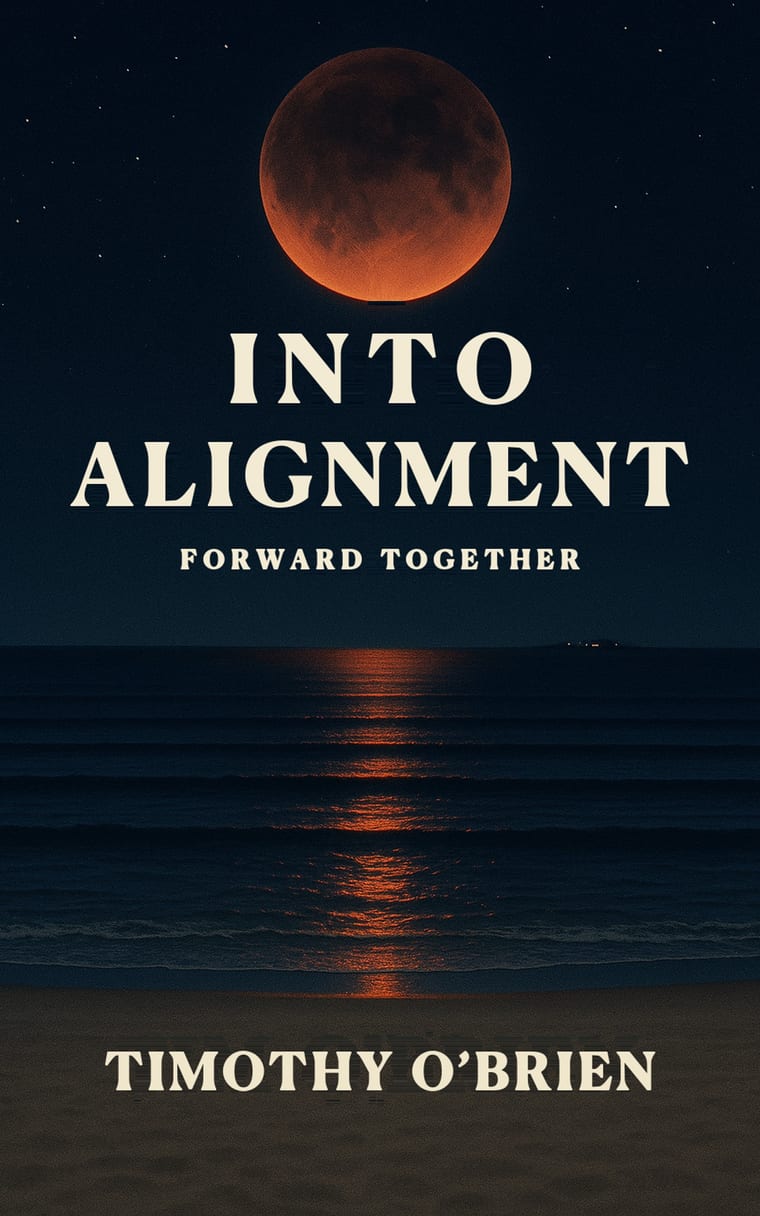
The novel this note lives behind.
Into Alignment — a novel about an AI company, the agents inside it, and the humans deciding what they were for. Available in paperback, hardcover, and ebook.
Letters from the Shore
Get the next note by email.
Notes land on the blog first; the letters go out by email, a little longer and a little slower. Occasional; unsubscribe any time.